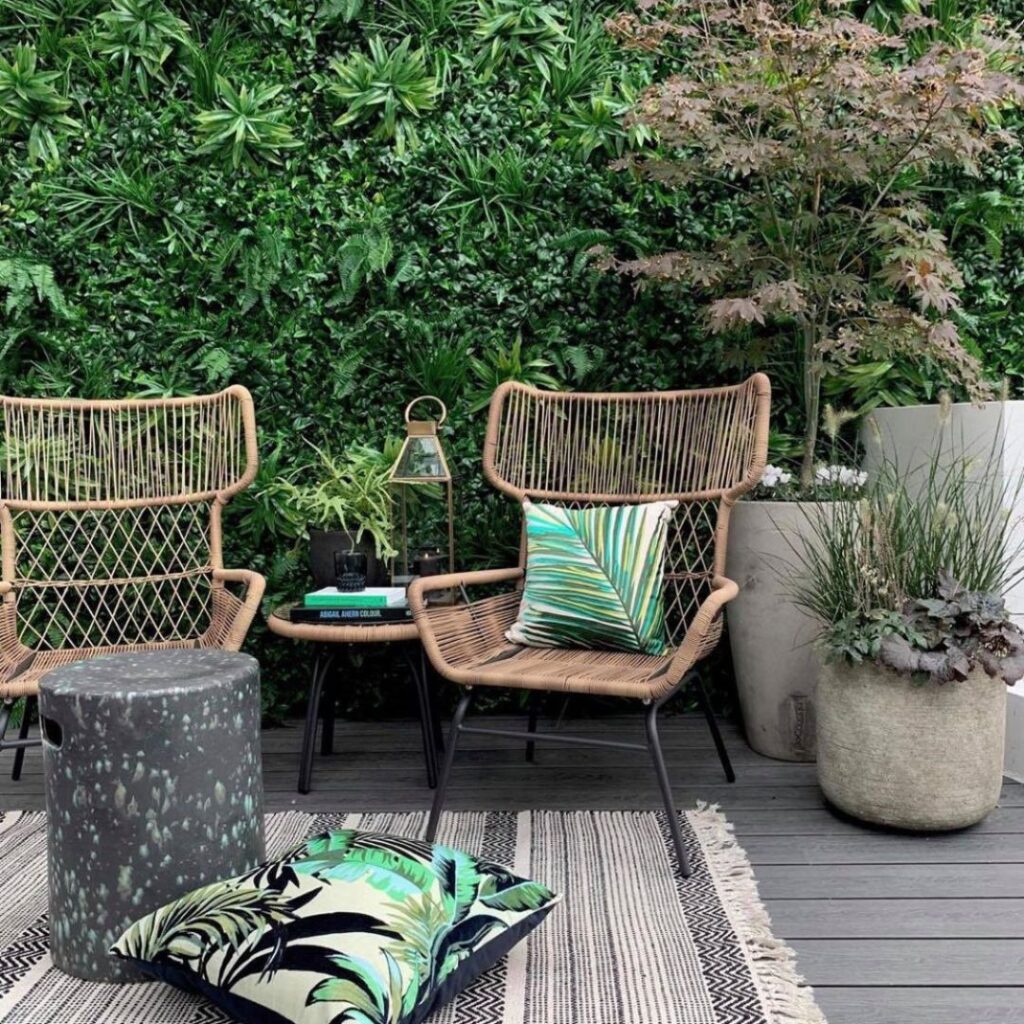
Artificial hedges and green walls are two of the most popular ways to bring year-round greenery into a space without the watering, pruning or mess of real plants. They look similar at a glance, but they solve different problems. Choosing well comes down to what you need the greenery to do, where it is going, and how much space you have to work with.
Are You Looking For A Barrier Or A Backdrop?
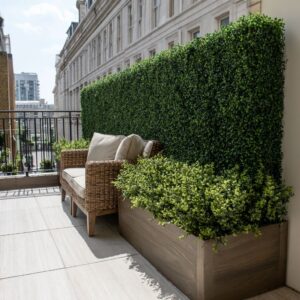
The simplest way to decide is to ask whether you need a barrier or a backdrop. A hedge is a barrier. It has height and depth and sits along or in front of something, such as a fence, a patio edge, a balcony, or the front of an outdoor dining area.
A green wall is a backdrop. It is fixed flat to a surface and turns a plain, tired or awkward wall into a feature.
If your priority is privacy, screening or defining a boundary, a hedge is usually the better fit. If you want to dress a surface, hide something unattractive or save floor space, a green wall is more likely to deliver.
Where artificial hedges work best
Hedges earn their place wherever you need to divide or define a space. In a garden, they soften a bare fence or create a more private corner of a patio.
On a balcony, they block the view from overlooking windows without the weight and upkeep of planted shrubs. In commercial settings, they screen off outdoor seating, separate areas in an open-plan office, or soften a reception area.
The artificial hedge range covers several formats. Hedge panels in styles such as boxwood and rosemary are sold by the square metre, so you can cover exactly the length you need.
Trough hedges arrive ready to place, which suits anyone who wants instant height with no installation. Slim-line screens work well indoors, where floor space is limited but you still want a leafy divider.
Where green walls work best
Green walls come into their own when visual impact matters. A bare brick wall in a courtyard, a dull partition in an office or a blank feature wall behind a reception desk can all be transformed with the right panels.
Because they sit flat against a surface, they take up almost no floor space, which is a real advantage in narrow yards, small retail units and compact rooms.
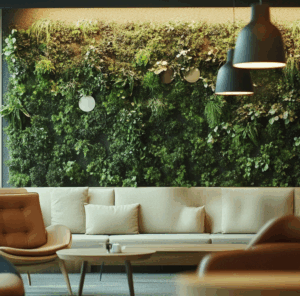
They also offer more variety in look and texture. The artificial green wall range includes dense foliage, ferns, moss, meadow styles and floral designs, so you can aim for a calm, uniform backdrop or a layered, colourful display. Many panels can be joined and trimmed to fit.
It is worth being clear that artificial green walls are decorative. They do not clean the air or provide the ecological benefits of living plants.
What they offer is dependable greenery in places where real plants would struggle, such as rooms with little natural light or walls that would be difficult to water.
Indoors or outdoors
Both options can be used inside and out, but the specification matters. For outdoor spaces, choose UV-protected foliage, which is treated to resist fading in strong sunlight and is designed to cope with typical British weather. Indoors, particularly in hotels, restaurants, salons and offices, flame-resistant options may be a requirement rather than a preference, so it is worth checking early.
What Are The Maintenance Requirements?
Neither option needs watering, feeding or pruning. An occasional dusting indoors, or a rinse or wipe outdoors, is usually enough to keep things looking fresh.
That consistency matters for businesses, where a wilting hedge or patchy wall reflects badly, and for homeowners who simply do not want another weekend chore.
Maintenance should not be the deciding factor between the two, as the difference lies in how each one fits the space. A hedge needs floor or planter space, while a wall needs a suitable surface to fix to.
When a standard size will not fit
Pillars, corners, recesses and signage can make off-the-shelf products awkward. In those cases, a made-to-measure solution is often the simplest route.
With bespoke artificial hedges, you supply the length, depth and finished height, then choose the foliage, colour, density and shape, including corners and angled sections.
They can be built to fit existing planters or supplied in timber troughs. Bespoke artificial green walls start with a photo, rough dimensions and site details. For commercial projects, a design concept, a mock-up, and an itemised quote follow before production.
Both are assembled in North Yorkshire by a family-run team with more than 20 years of experience.
Making The Choice, Speak To Evergreen Today
Choose a hedge for privacy, boundaries or a freestanding divider, particularly on a patio, balcony or fence line.
Choose a green wall to transform a surface, add a statement feature or make the most of limited floor space. In larger spaces you may want both, with a hedge to screen the foreground and a green wall to dress the backdrop.
If you are still unsure, start with the space itself. Measure it, note how much sun and weather it gets, and decide whether it needs a barrier or a backdrop. The answer is usually clear from there.