
Artificial hedging is now used well beyond the odd decorative planter. It screens gardens from neighbours, hides tired fencing, divides restaurant terraces and softens office receptions, often in places where a living hedge would struggle to grow or take years to fill out.
This guide explains how artificial hedging is made, how to use it for privacy, where it works in commercial settings and what UV and fire ratings actually mean, so you can work out what your space needs before you start measuring.
What Is Artificial Hedging?
Artificial hedging is foliage moulded from plastic, usually polyethene, and fixed to a backing grid so it can be joined into a continuous screen. Most designs imitate classic hedge plants such as boxwood, buxus, ivy and rosemary, and some mix in flowers or ferns for a softer finish.
It generally comes in three formats. Hedge panels are flat squares that clip together and fix to an existing fence, wall, or frame, making them the most flexible way to cover a large area.
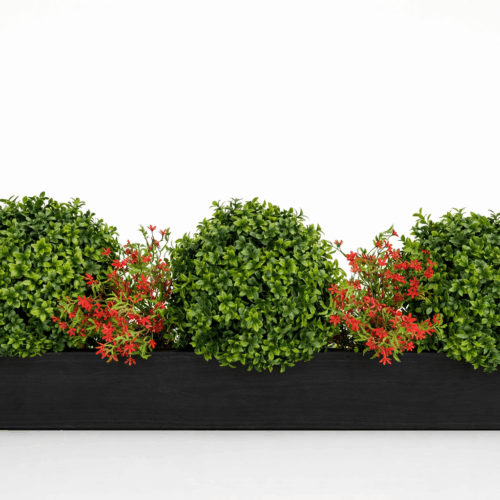
Troughed hedges are ready-made blocks of hedge set in a timber planter, so they stand on their own and can be moved. Freestanding screens are panels mounted on a base, designed to divide a room or terrace without fixing anything to the building.
Choosing the right format matters more than choosing the plant style, because it decides how the hedge is supported and how easily it can be moved or changed later.

Using Artificial Hedging for Privacy
Privacy is the most common reason people choose artificial hedging, and it is in this area that the material has a clear advantage. A newly planted laurel or privet hedge can take several years to reach a useful height and density, whereas an artificial screen gives full cover from the day it goes up. It also stays the same width, so it never spreads across a narrow path or onto a neighbour’s side of the boundary.
In gardens, the usual approach is to fix hedge panels to an existing fence or trellis. This enhances the look of a plain boundary and closes the gaps between slats, which are often where overlooking occurs.
On balconies and roof terraces, panels attached to railings can screen the view from neighbouring flats, although it is worth checking your lease or building rules first, as some restrict what can be fixed to balustrades.
Height and density are the two things to think about. In England, a boundary fence or wall can generally be up to two metres high without planning permission, or one metre next to a road used by vehicles.
Cladding an existing fence does not change its height, but if you plan to add a frame to raise a boundary, check with your local planning authority first. For density, look for foliage with several leaf layers and check side-on photographs, as thin single-layer panels can leave the view behind them visible.
It also helps to be realistic about noise. Artificial hedging is sometimes described as a sound barrier, but foliage on its own does very little to stop sound. Fixed to a solid fence or wall it can soften echo and make a space feel calmer, but it is the solid structure behind it that blocks noise. If noise is the main problem, start with the right fence and treat the hedging as the finish.
Artificial Hedging in Commercial Spaces
Businesses use artificial hedging for many of the same reasons as homeowners, plus a few of their own. On restaurant and bar terraces, troughed hedges and freestanding screens define the seating area, shield diners from the street and can be moved when the layout changes.
Because they need no soil or watering, they also avoid the drainage, weight and upkeep that come with large planters of real shrubs.
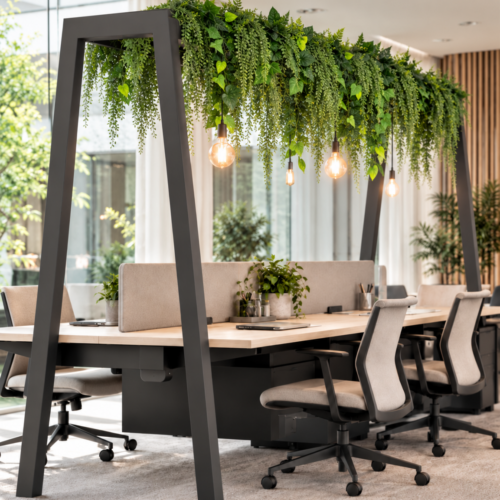
Indoors, offices use hedge screens to break up open-plan floors and create quieter zones without building partitions. Hotels, spas and salons use them to frame entrances and reception desks, while retailers use them for window displays and seasonal backdrops. At exhibitions and events, lightweight panels can turn a plain stand into a branded space in a few hours and then be reused at the next show.
Commercial settings do bring extra responsibilities. Indoors, particularly in buildings open to the public, the fire performance of decorative materials matters, and your fire risk assessment may require evidence that any materials you install have been tested.
Outdoors, hedging near a public walkway needs to be secured so it cannot be lifted or blown over. Where a screen has to fit an awkward space or match a brand colour, a bespoke hedge made to exact dimensions is often simpler than adapting a standard product.
UV Protection and Fire Resistance Explained
Two specifications recur when choosing artificial hedging, and each addresses a different problem.
UV protection is about colour. Sunlight breaks down the pigments in untreated plastic foliage, which is why cheap outdoor greenery can fade to a blue or grey tint within a season or two. UV-protected hedging contains stabilisers that slow this process considerably, so it is the right choice for anything outdoors or behind a sunny window.
No outdoor plastic lasts forever, and south-facing positions will always fade faster, but UV protection is the difference between a screen that looks good for years and one that needs replacing quickly.
Fire resistance is about safety. Flame-retardant (FR) hedging is treated to resist ignition and prevent a fire from spreading. It matters most indoors, especially in offices, hotels, restaurants, shops, and other public spaces.
When comparing FR products, ask which test standard they are certified to, such as BS 476 or BS EN 13501-1, and keep a copy of the certificate, as a fire risk assessor or landlord may ask to see it. [Client to confirm: the standard Evergreen’s FR hedge panels are tested to, to be named here.]
Some products carry both ratings, which is often the safest choice for covered outdoor bars, conservatories and atriums that see strong sunlight and public footfall.

Choosing a Hedge Style
Boxwood and buxus are the classic choices. Their small, dense leaves create a neat, formal finish that suits everything from cottage gardens to hotel entrances, and they are the closest match to clipped box hedging. Artificial box has become particularly popular in the UK since box blight and box tree caterpillar have damaged so many real box hedges.
Ivy gives a looser, more natural look and works well where you want a boundary to feel established rather than clipped. Rosemary and other textured foliage add depth and a slightly more contemporary feel, while flowering and fern mixes bring colour, which suits interiors and hospitality spaces where the hedge is part of the decor rather than just a screen.
The surroundings are the best guide. Formal box sits well with clean lines and modern architecture, while mixed or trailing foliage blends more easily with real planting at the edges of a garden.
Installing and Caring for Artificial Hedging
Installation starts with accurate measurements. Measure the height and width of the area, then allow for joins and any trimming around posts or corners. Hedge panels are usually fixed with cable ties to a fence, trellis or mesh, or with screws or staples to a timber frame. Working from the bottom up and interlocking each panel firmly helps the joins disappear into the foliage.
Wind is the main thing to plan for outdoors. A fence clad in hedging catches more wind than bare slats, so make sure the posts and panels behind it are sound before adding anything, and use extra fixings on exposed sites.
Troughed hedges and freestanding screens should sit on level ground and be weighted or secured where they are exposed.
Care is minimal. A rinse with a hose or a wipe with a damp cloth removes dust and pollen, and a soft brush clears leaves caught in the foliage. Avoid pressure washers and harsh chemicals, which can damage leaves and wear away UV treatment, and check the fixings after storms.
Common Questions About Artificial Hedging
How long does artificial hedging last outdoors?
UV-protected hedging typically lasts several years outdoors, depending on how much direct sun it receives. Shaded and north-facing positions hold their colour longer than exposed, south-facing ones.
Can artificial hedging be cut to size?
Most hedge panels can be trimmed with scissors or snips to fit around posts, corners and edges, and joined together to cover larger areas.
Does artificial hedging need planning permission?
Cladding an existing fence or wall usually does not require permission, but raising the overall height of a boundary may. If you are unsure, check with your local planning authority before you build.
Finding the Right Artificial Hedging for Your Space
The right artificial hedging depends on what you need it to do, whether that is screening a boundary, dividing a terrace or meeting fire safety requirements in a public building.
Once you know the format, the setting and the ratings it needs, choosing a style is the easy part.
You can compare panel, trough, and screen options across our range of artificial hedges, and our team can advise on bespoke sizes if your space does not suit a standard product.